09 May 2026
Posted by Suchi
Junior & Young Writers Week 3: Show, Don’t Tell
Hi Writers,
This week, we explored one of the most important writing techniques of all: Show, don’t tell. We looked at how writers can bring stories to life by helping readers see, hear, feel and imagine what is happening, instead of simply telling them. The sessions were full of creativity, laughter, mystery objects, and some brilliant descriptive writing.
Check-in: How was your week... as a fidget toy?
To start the day, everyone described their week as if it were a fidget toy. It was such a fun way to warm up and get everyone thinking creatively.
Some of the answers included:
● A beach ball because the week was calm but not very exciting
● A pen because it started normal and then became a bit strange
● Knee dough because the week got squashed but bounced back again It was funny, imaginative, and got everyone chatting straight away.
Mystery Box Challenge
Next came the mystery box activity. Everyone took turns reaching inside the box and describing the object they could feel without saying what it actually was.
The junior writers came up with some brilliant clues:
● “Made of metal, has holes in it, used for Christmas dinner…” Answer: Potato masher ● “You wear it in winter and it has a fluffy bit on top.” Answer: Pom-pom hat ● “A toy weapon.” Answer: Sword
● “Long, bendy, made of rope and wood.” Answer: Skipping rope
The Young Writers became especially creative with this challenge and sometimes completely went off track in the best way possible, turning objects into dinosaurs, snakes, beds, and even Pinocchio.
Why do writers ‘show’ instead of ‘tell’?
We then talked about why writers describe things instead of just naming them straight away.
The groups discussed:
● How descriptions help readers picture things
● How senses like touch, smell and sound create atmosphere
● How readers enjoy figuring things out themselves
● How it makes stories feel more interesting and immersive
We also talked about balance. Too much showing all the time can become exhausting to read. Sometimes simple telling works best, especially for less important moments.
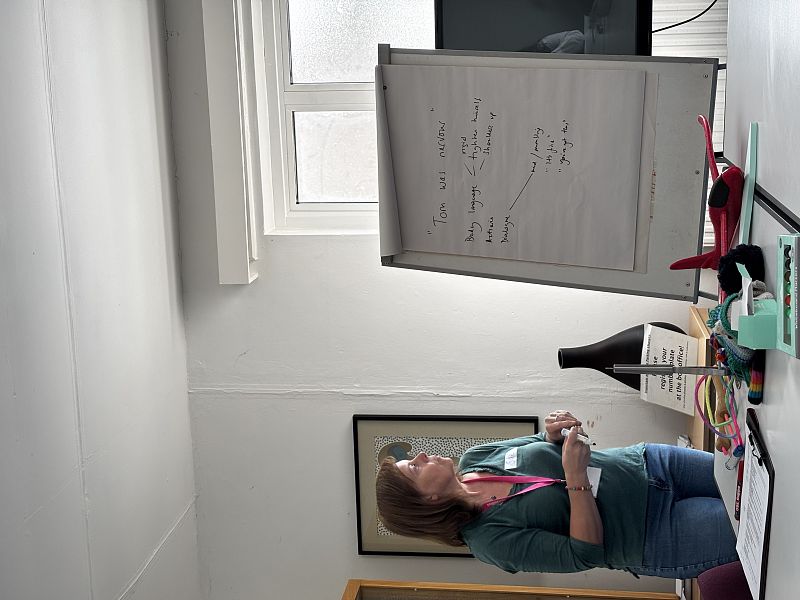
As Sue said in the session: “Show the important moments. Tell the less important parts.” Turning ‘telling’ into ‘showing’
We practised changing simple sentences into more vivid descriptions. Instead of: “Tom was nervous.”
The writers suggested things like:
● Sweating
● Avoiding eye contact
● Shaking hands
● Fidgeting and shifting from foot to foot
● Muttering to himself
Writing Time
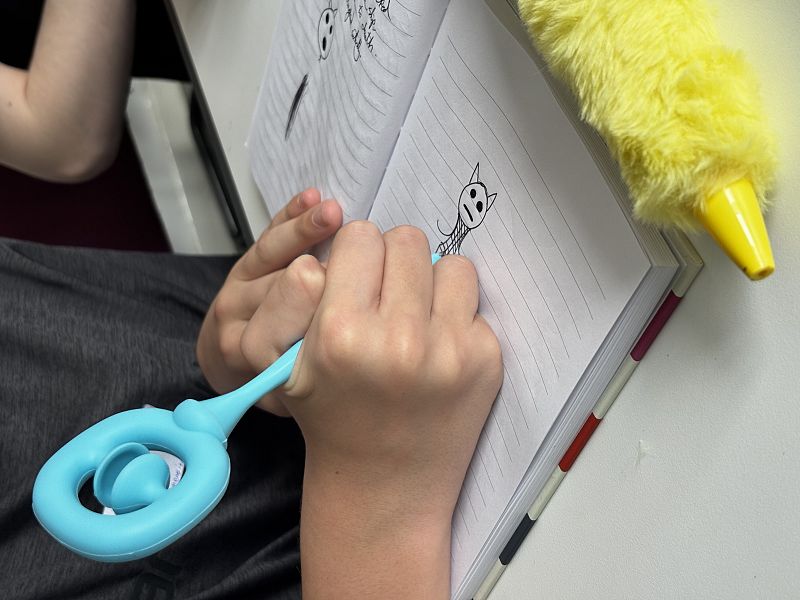
The Junior Writers created stories inspired by the mystery box objects and used lots of sensory detail in their writing. They also used colourful fidget pens and toys while working, which everyone loved.
Some standout lines included:
● Elsie: “Tears rolled down cheeks and the dry land flourished.”
● William: “Sweat was pouring from his brow.”
Evan continued his ongoing story about Bob, an unlucky character everyone already knows and loves. The storytelling and narration were brilliant, and it was lovely seeing the group already invested in the character. Alice cleverly included all the fidget toys in her story, linking everything together creatively.
The Young Writers used story cards to create completely new stories using random characters, settings, obstacles and goals.
The brilliant combinations included:
● A rude character trapped in a library during a storm
● A sensitive character dealing with handcuffs on a cruise ship
● An honest character stranded on the moon searching for someone And some amazing lines too:
● Catherine: “Obnoxiously expensive coffee” and “dollop of rain”
● Eddy: “Felt squeezy and lightheaded” and “dark watchers laughed silently” ● Sonny: “Kicked some dust and threw up into the dark” and “looked at the blue and green blob and cursed everyone”
The humour in their stories was especially strong this week. The ideas were funny, strange, dramatic, and completely unique.
To finish, the young writers picked colour cards and used them to inspire another quick piece of writing.
Eddy even turned the task into a song, titled: “Twinkle Twinkle Molten Sulphur”
By the end of the session, it was clear that everyone had really understood the idea of show, don’t tell. The stories felt vivid, emotional and full of personality. The writers didn’t just tell us what was happening, they made us experience it too.
Suchi


Archive
Junior & Young Writers Week 3: Return From The Magical World
Junior & Young Writers Week 2: African Mythology
Problems, Problems, Problems...
Cautionary Tales & Christmassy Opening Lines
You've Gotta Have Pace, Pace, Pace
Junior & Young Writers Week 1: Alien Encounters
Junior & Young Writers: Week 5 - Play on Words Pt. 2
Junior & Young Writers: Week 11 - end of term showcase [build a bard workshop]
Junior & Young Writers: Week 10 - Greek Theatre - chorus stories
Junior & Young Writers: Week 9 - Greek Origin Stories - Spring
Rubber Ducks & Writing Festivals
Junior & Young Writers: Week 7 - Greek Hero Stories [the 12 labours of Hercules]
Junior & Young Writers: Week 12 [Wild Words] - Stuff & Things
Junior & Young Writers: Week 11 [Wild Words] - World Building 2
Junior & Young Writers: Week 10 [Wild Words] - World Building
Junior & Young Writers: Week 9 [Wild Words] - Mystery & Choose Your Own Adventure
Junior & Young Writers: Week 8 [Wild Words] - Spooky Sequels & Potion Poems
Junior & Young Writers – Week 10 (Writers’ Inspiration) – Final Showcase
Junior & Young Writers – Week 9 (Writers’ Inspiration) – Editing & Performance Tips
Junior & Young Writers – Week 8 (Writers’ Inspiration) – Cuteness
Time goes on by Tavinder Kaur New
Junior & Young Writers – Week 7 (Writers’ Inspiration) – Natural Solutions
Junior & Young Writers – Week 6 (Writers’ Inspiration) – The Language of Fruit and Veg
Junior & Young Writers – Week 5 (Writers’ Inspiration) – Adventures In Space
Tinklebobs and Bedraggled Angles
Junior & Young Writers – Week 4 (Writers’ Inspiration) – Our Environment
Fortune Tellers & Future Letters
Junior & Young Writers – Week 3 (Writers’ Inspiration) – Home
Young Writers - Week 10 (The Art of Writing) – Final Week Showcase
Junior Writers - Week 10 (The Art of Writing) – Final Week Showcase
Young Writers – Week 9 (The Art of Writing) – Choose Your Own Adventure
Junior Writers – Week 9 (The Art of Writing) – Choose Your Own Adventure
Young Writers – Week 8 (The Art of Writing) – Sequel Stories
Junior Writers – Week 8 (The Art of Writing) – Sequel Stories
Young Writers – Week 7 (The Art of Writing) – Picture Prompts
Junior Writers – Week 7 (The Art of Writing) – Picture Prompts
Young Writers - Week 6 (The Art of Writing) - Script-writing & Dialogue
Junior Writers - Week 6 (The Art of Writing) - Script-writing & Dialogue
Junior Writers – Week 5 (The Art of Writing) – Poetry
Young Writers - Week 5 (The Art of Writing) - Poetry Potions
Edward The Martyr - A Competition!
Mood Boards and Postcards from Space
Young Writers - Week 3 (The Art of Writing) - PLOT
Junior Writers - Week 3 (The Art of Writing) - PLOT
Moomin Stories and Hollywood Pitches
Young Writers - Week 2 (The Art of Writing) - Genre & Setting
Junior Writers - Week 2 (The Art of Writing) - Genre & Setting
Prompts, Dialogues, and Cliché
Story Structure Part One: Exposition and Beyond...
Young Writers - Week 1 (The Art of Writing) - Character
Young Writers - week 4 - Nature Writing [animals & wildlife]
Junior Writers - week 4 - Nature Writing [animals & wildlife]
Young Writers - week 3 - Nature Writing [trees/plants/flowers]
Junior Writers - week 3 - Nature Writing [trees/plants/flowers]
Young Writers - week 2 - 'fractured fairy tales'
Junior Writers - week 2 - 'fractured fairy tales'
Writing Competition - Stories From Our Streets
Stories From Our Streets Community Activity Pack
Thinking in-quiet, after the fire
Ekphrastic Jukebox - Writing to Music
ArtfulScribe LitFest Community Showcase 2023
Young writers exercise their creative power
The Mousetrap - Mayflower Young and Junior Writers Investigate Mystery!
Stories From Our Streets Launch!
Interview: In Conversation with Dr Victoria Leslie
The Missing Farmer/ Blackout Poetry & DADA
Exploring this wonderful World
Using props to create characters/ working as a writing room
Stories of the Dust and Character Questions